More Than Half of Organizations Have an AI Skills Shortage. Are You Falling Behind?

Workera Team
The number of organizations with an AI skills shortage doubled over the last 12 months. That's the key takeaway from the 2025 Digital Leadership Report, a survey of senior technology decision-makers conducted by Nash Squared. Over 2,000 respondents from 62 countries took part, with topics including AI, skills and talent, and the role of the digital leader.
According to the report, 51% of technology leaders said their business has an AI skills shortage, up from 28% last year. AI proficiency isn't in decline — employees around the world have undoubtedly gained valuable skills and experience over the last 12 months. However, more companies are waking up to the fact that they need sharper AI skills to stay competitive.
If half of all organizations are on track with AI and half are falling behind, where does your business stand? The reality is, you might not have the answer. Without accurate skills verification, it's impossible to understand where the gaps lie and how they affect your business.
This blog will help you identify where your organization stands, what areas need work, and how to build a future-proof, AI-ready workforce.
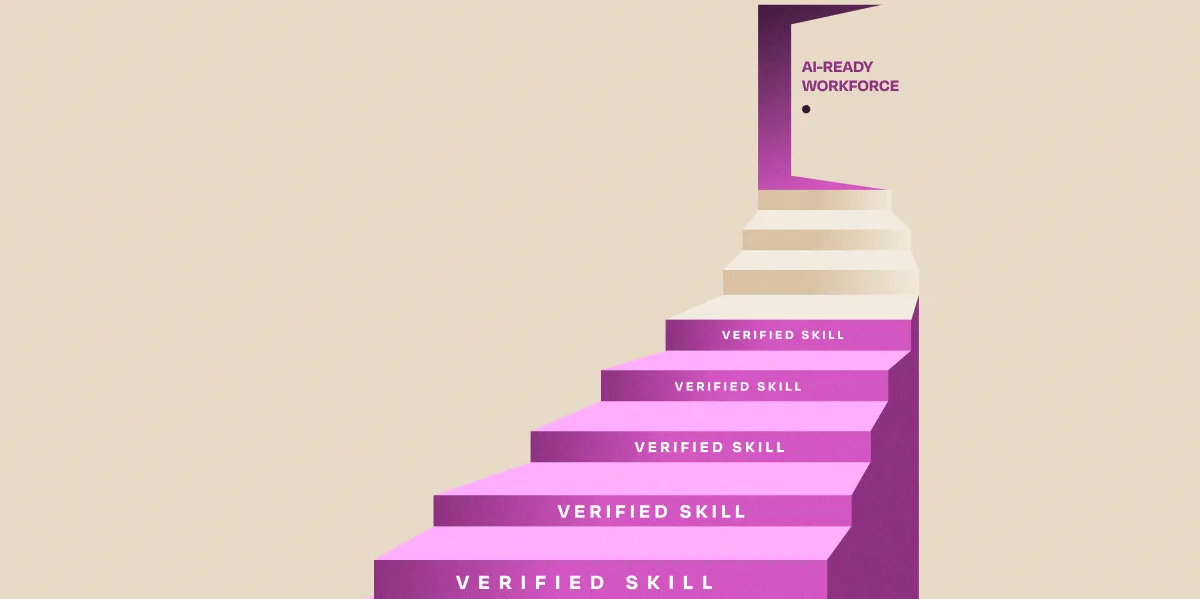
Verified skills are essential
Half of technology leaders say their organization has an AI skills shortage, but how many of them know for sure? Common approaches to skills assessment, such as self-evaluation or peer reviews, deliver skewed results — most employees under- or overestimate their own ability levels.
To start addressing skills shortages, you need accurate, verifiable skills intelligence; understanding your employees' strengths and weaknesses sets you on the path to improvement. Organizations that rely on vague, biased estimates instead of data-based assessments are trying to move forward in the dark and will inevitably get lost on the way.
It's worth noting that AI is a particularly hard "behavior" to measure. That's because it isn't a single behavior — it's a category comprising dozens of individual behaviors and competencies. For example, a technical employee may need to be proficient in MLOps, which breaks down into skill areas like data management, model deployment, and performance optimization. Each of these skill areas can be divided even further into a set of granular behaviors.
Generic, surface-level assessments fall short for highly specific AI skills. You need precise, real-time information on exactly where your employees stand to identify and address the skills shortages that are holding your business back.
Which skill gaps matter most?
An AI skills shortage means something different to every organization. Industries apply AI in different ways, and even businesses within the same industry have varying needs and priorities.
A software engineering enterprise might integrate AI into its workflows to automate repetitive tasks and speed up development. To get the best return on its AI investments, the organization needs engineers who are skilled in coding tools like GitHub Copilot or Cursor. In contrast, employees at a creative agency require a different skill set to use AI for ideation and content creation.
To understand the areas of improvement that matter most for your employees, you should start by defining your organization's goals and what you want to achieve with AI. You can then identify the skills that are most important for each role. We built our integrated AI agent mentor, to simplify the process and ensure skills verification aligns with your business goals.
Workera can quickly learn each user's job context, identify the most relevant skills, verify those skills, and provide instant feedback. For a software engineering enterprise, that might mean simulating coding challenges and role-specific problem-solving tasks. At the creative agency, Workera can set interactive assignments to evaluate how well employees use prompts to generate images, text, or music.
Close the gap with targeted upskilling
AI is moving fast, and the skills that organizations need to stay ahead are constantly changing. Without consistent upskilling, an employee who's proficient in ChatGPT today might be falling behind in just a few months' time. The good news is that closing skills gaps doesn't have to be complicated. With a targeted approach, you can focus on the skills that matter and avoid wasting time on those that don't.
Workera provides personalized mentoring based on an employee's skills data and how they learn best — whether that's through direct practice or tailored learning materials. Unlike one-size-fits-all programs that benefit some learners more than others, we ensure each employee has exactly what they need to improve. You can also track progress and see how individuals, teams, and departments are evolving across the most important skills.
Closing skills gaps starts with verified skills intelligence. To find out how Workera can help your organization get ahead with AI, book a demo today.
Category
Blog
Trending Updates

Blog
The AI Productivity Paradox: Why High Usage Isn't Delivering Transformation

Blog
Beyond the Copilot: Why "Systems of Intelligence" Require Precision Skills Data
News
Pearson Agrees to Acquire Workera, a Pioneer in AI-Native Enterprise Assessment and Skills Verification